
Cork7 tricks, from takeoff to landing
For a cork, combine A/D with S at the jump lip. Use W for a bio, or a left/right arrow for a flatspin. Set the combination at takeoff, then leave time to land.
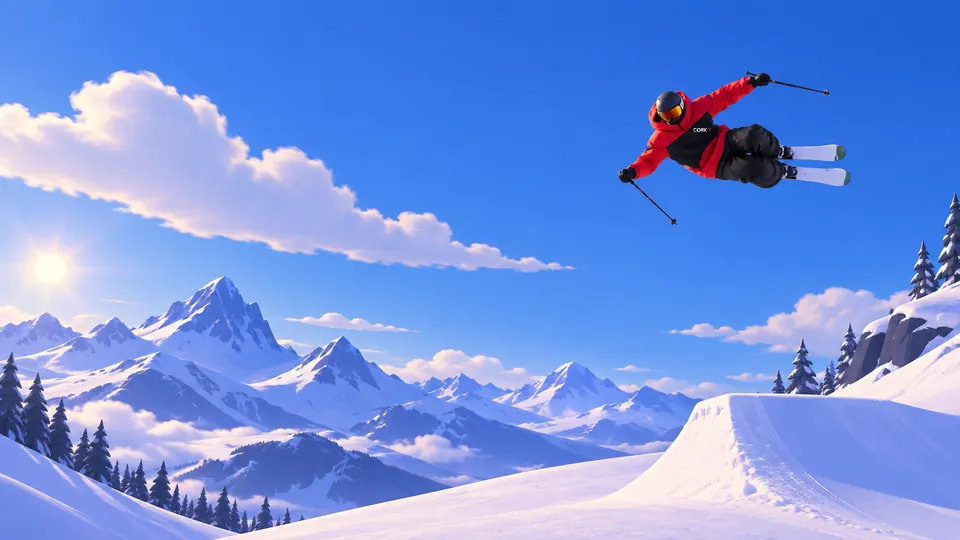
Choose an axis before you jump
The trick names describe the movement, not a combo code. Start with a jump that gives you time to see the rotation. Decide which direction you will spin, then add one flip or roll input at takeoff.
| Target | Takeoff inputs | Movement to look for |
|---|---|---|
| Cork | A or D + S | Spin with a backward lean |
| Bio | A or D + W | Spin with a forward lean |
| Flatspin | A or D + left/right arrow | Spin with the body lying flatter |
| Rodeo | Up arrow + A/D + S | Backward, feet-over-head rotation |
| Misty | Up arrow + A/D + W | Forward, feet-over-head rotation |
These combinations are from the official controls guide. They apply to the default keyboard mapping. Check your full input sheet if you have remapped a key or use a controller.
First cork: a repeatable practice line
- Find a kicker you can already jump and land without a trick.
- Approach it with steady speed. Load Space before the lip if you want extra pop, then release.
- Set A or D together with S at takeoff. The official guide gives a 0.25-second window for the spin-and-flip combination.
- Watch the rotation instead of immediately adding another axis. Let the motion settle before the snow reaches you.
- Release the grab, if used, and try to land with the skis aligned with travel.
If the first attempt fails, keep the same kicker and change one thing on the next lap. That makes a timing change easier to understand than switching park, speed and keys together. This is a suggested practice drill, not a guaranteed scoring technique.
Why the landing name can surprise you
A late spin does not create the same takeoff as a simultaneous spin and flip: the official instructions say it tilts the existing flip. The final trick name reflects completed motion, including late rotation. Small flat-ground hops and quick taps also do not satisfy the same movement conditions as a committed takeoff.
A frontflip or backflip is relative to the rider, including when riding switch or after a 180. Reversing an input first slows the existing flip; it is not an instant reset. If your rider appears to hesitate, stop combining opposing corrections and return to a simpler jump.
Add a grab after the rotation is familiar
Shift is mute, Q is tail and E is Japan. Hold the grab rather than tapping it. The official guide describes 0.25 seconds as enough to count a grab and one second for the full 25% rotation bonus; another grab adds 5%. Its two-grab 720 example is 6,000 × 1.3 = 7,800, before other modifiers.
Do not hold the grab all the way into the snow just to chase the multiplier. Release to open up for landing. The scoring guide explains why protecting the line matters more than the isolated rotation number.
Chill, switch and variety
Hold down arrow as you leave the lip to use chill. It makes the whole air turn at half speed; pressing it later does nothing, and a grab does not speed it up. Slower rotation is a style choice that changes your timing, not a way to force extra rotations.
The official guide lists a ×1.25 switch modifier on spin points and a 15% upside-down bonus. Avoid adding these into a homemade final-score calculator: the order of every modifier is not fully specified in the public overview.
Repeated tricks lose value. Change direction, stance or flip, but do so after you can land each variation. Keep a replay of a successful line so you can compare takeoff and landing, rather than trying to remember a fast movement. Then return to the game and practise one variation.